Last updated · Researched from official sources · By Studyforge Labs
Earth has 7 continents and 5 oceans, and learning their names is one of the first big steps in geography for young children. This guide gives parents and teachers kid-friendly facts, a six-week learning plan, easy games and a short quiz, written so you can read it aloud to a child aged about 6 to 8.
Quick answer: The 7 continents, from biggest to smallest, are Asia, Africa, North America, South America, Antarctica, Europe and Australia (often called Australia/Oceania). The 5 oceans, from biggest to smallest, are the Pacific, Atlantic, Indian, Southern and Arctic. All five oceans are joined together as one big global ocean that covers about 71% of Earth, and the Southern Ocean around Antarctica is the newest one to be named on maps.
Continents and oceans key facts
| Key fact | Details |
|---|---|
| Number of continents | 7 (Asia, Africa, North America, South America, Antarctica, Europe and Australia/Oceania), although some places teach 6. |
| Largest continent | Asia, at about 17.2 million square miles, home to about 6 in 10 people on Earth. |
| Smallest continent | Australia (Australia/Oceania), at roughly 3.3 million square miles. |
| Number of oceans | 5 (Pacific, Atlantic, Indian, Southern and Arctic), all connected as one global ocean. |
| Largest ocean | The Pacific. It is bigger than all the land on Earth put together. |
| Smallest ocean | The Arctic, around the North Pole. It is also the shallowest. |
| Newest named ocean | The Southern Ocean, which National Geographic added to its maps in 2021. |
| Coldest continent | Antarctica, where the lowest temperature ever recorded on Earth, about −128.6°F, was measured. |
| Deepest place | The Challenger Deep in the Pacific’s Mariana Trench, about 36,000 feet down. |
| Good age to start | Around 5 to 8, using short sessions of 10 to 15 minutes. |
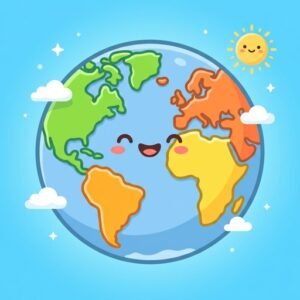
Practice with Continents & Oceans Kids
Continents & Oceans Kids helps children aged 6 to 8 learn the world with drag-and-drop map puzzles for all 7 continents and 5 oceans, 12 learning pages of fun facts and animals, and 4 friendly quizzes with 32 kid-sized questions, plus read-aloud support for early readers. It is a one-time unlock with no ads, works offline and collects no data.
What are the 7 continents?
A continent is a very large area of land. Most continents hold many countries, but Antarctica has none. Try explaining it like this: “Countries are like rooms, and continents are like whole houses. Our house is North America.”
Most schools in the United States teach seven continents, but some countries teach six. Some combine North and South America into one continent called America, and some count Europe and Asia as one continent, Eurasia, because they share the same piece of land. Neither way is wrong; people simply group the land differently.
The table below shows each continent from largest to smallest. Areas and populations are rounded, and different sources give slightly different numbers.
| Continent | Approx. area | Approx. population | A famous animal | A fun fact |
|---|---|---|---|---|
| Asia | 17.2 million sq mi (44.6 million km²) | 4.8 billion | Giant panda, Bengal tiger | Mount Everest, the highest point on Earth, is in Asia. |
| Africa | 11.6 million sq mi (30.2 million km²) | 1.5 billion | African elephant, giraffe | Africa is more than three times the size of the United States. |
| North America | 9.4 million sq mi (24.4 million km²) | 620 million | American bison, bald eagle | Greenland, the world’s largest island, is geographically part of North America. |
| South America | 6.9 million sq mi (17.8 million km²) | 440 million | Sloth, jaguar | Angel Falls in Venezuela is the tallest waterfall in the world. |
| Antarctica | 5.5 million sq mi (14.2 million km²) | No permanent residents (visiting scientists only) | Emperor penguin | Its ice sheet is about 6,500 feet thick on average. |
| Europe | 4 million sq mi (10.4 million km²) | 745 million | European hedgehog, reindeer | Europe is only a little bigger than Canada. |
| Australia/Oceania | 3.3 million sq mi (8.5 million km²) | 47 million | Kangaroo, koala | The platypus lives here. It is a mammal that lays eggs. |
Population figures are rounded 2025 estimates based on United Nations data. The Australia/Oceania figure includes the Pacific island nations, and the Europe figure counts all of Russia’s people, as UN data does.
Asia
Asia is the biggest continent, and it has the most people. Together, China and India hold more than a third of everyone on Earth. Asia also has more than 50 of the world’s tallest mountains, including Mount Everest, which rises more than 29,000 feet. Look for giant pandas in China and Bengal tigers in India and Bangladesh.
Africa
Africa is the second-largest continent. The Nile, one of the longest rivers in the world, flows more than 4,100 miles through it. Its grassy plains, called savannas, are home to lions, giraffes and elephants.
North America
North America is the third-largest continent. It includes Canada, the United States, Mexico, Central America and the Caribbean islands, and it stretches from the icy Arctic to warm rainforests. If you live in the United States, this is your home continent.
South America
South America is the fourth-largest continent. It is home to the Amazon rainforest and Angel Falls, the world’s tallest waterfall at about 3,212 feet. Sloths hang in its trees, and jaguars hunt in its forests.
Antarctica
Antarctica sits at the bottom of the world, around the South Pole. It is the coldest, windiest and driest continent, and almost all of it is covered in ice. Nobody lives there all year; scientists from different countries visit research stations instead. Emperor penguins and seals live along its coasts.
Europe
Europe is the second-smallest continent, but it has many countries close together, such as France, Germany, Italy and Spain. Europe and Asia are joined, and the Ural Mountains in Russia are usually used as the dividing line. Hedgehogs, red foxes and, in the far north, reindeer live here.
Australia/Oceania
Australia is the smallest and flattest continent. The name Oceania is often used for Australia plus Pacific islands such as New Zealand, Fiji and Papua New Guinea. Because this land was cut off from other continents for millions of years, it has animals found nowhere else in the wild, like kangaroos, koalas, platypuses and Tasmanian devils.
What are the 5 oceans?
Here is a big idea for kids: there is really only one ocean. All of it is connected, and it covers about 71% of our planet. To make it easier to talk about, people split it into five named parts: the Pacific, Atlantic, Indian, Southern and Arctic oceans.
For a long time, maps showed only four oceans. The Southern Ocean, which circles Antarctica, is the newest to be named. The U.S. Board on Geographic Names has used the name since 1999, NOAA (the National Oceanic and Atmospheric Administration) counts it as one of five ocean basins, and National Geographic added it to its maps on World Oceans Day, June 8, 2021. The international body that sets ocean borders has not formally agreed on it yet, so older books may still show four.
The table below lists the oceans from largest to smallest. Numbers are rounded, and they vary between sources because ocean borders can be drawn in slightly different places.
| Ocean | Approx. area | Deepest point (approx.) | A sea creature that lives there |
|---|---|---|---|
| Pacific | 65 million sq mi (169 million km²) | Challenger Deep, Mariana Trench: about 36,000 ft (10,900 m) | Giant Pacific octopus |
| Atlantic | 33 million sq mi (85 million km²) | Brownson Deep, Puerto Rico Trench: about 27,500 ft (8,400 m) | Atlantic bluefin tuna |
| Indian | 27 million sq mi (71 million km²) | Java Trench: about 23,600 ft (7,200 m) | Dugong (a gentle “sea cow”) |
| Southern | 8.5 million sq mi (22 million km²) | Factorian Deep, South Sandwich Trench: about 24,400 ft (7,400 m) | Antarctic krill |
| Arctic | 6 million sq mi (15.6 million km²) | Molloy Hole, Fram Strait: about 18,200 ft (5,550 m) | Narwhal |
Some sources, including NOAA, put the Pacific at about 60 million square miles because they draw its edges differently. Either way, it is by far the biggest.
Pacific Ocean
The Pacific is the largest and deepest ocean. It covers more than 30% of Earth’s surface and holds almost twice as much water as the Atlantic. Its deepest spot, the Challenger Deep, is so deep that if you dropped Mount Everest into it, the mountaintop would still be underwater.
Atlantic Ocean
The Atlantic is the second-largest ocean. It lies between the Americas on one side and Europe and Africa on the other. Fun fact: the Atlantic is slowly getting wider, because North America and Europe drift apart by about one inch each year.
Indian Ocean
The Indian Ocean is the third-largest ocean. It is named after India and sits between Africa, Asia and Australia. Its warm tropical waters are home to coral reefs, sea turtles and dugongs, gentle mammals that graze on seagrass.
Southern Ocean
The Southern Ocean surrounds Antarctica, and its northern edge is usually drawn at a map line called 60 degrees south. The Antarctic Circumpolar Current flows all the way around Antarctica and carries more water than any other ocean current. Tiny shrimp-like animals called krill live here in huge numbers, and a grown blue whale can eat four to eight tons of them in a single day during its feeding season.
Arctic Ocean
The Arctic Ocean, around the North Pole, is the smallest and shallowest ocean, about 1.5 times the size of the United States. Much of it is covered by floating sea ice. Polar bears hunt on the ice, and narwhals, whales with a long spiral tusk, swim below.
How to teach continents and oceans to kids
Young children learn best through short, playful sessions repeated often. This six-week plan uses about 10 to 15 minutes a day, three or four days a week. Adjust the pace to suit your child.
- Week 1, land and water: Open a globe or world map and ask, “Is there more blue or more green and brown?” Explain that blue is water. Put a sticker where you live.
- Week 2, the 7 continents: Introduce two or three continents a day. Say each name together and trace its shape with a finger. Learn the continent memory sentence below.
- Week 3, the 5 oceans: Trace a path through the water around the globe to show that all the oceans connect. Learn the ocean memory sentence.
- Week 4, animals and fun facts: Pick one animal for each continent and ocean (see the tables above). Draw them, match pictures to the map, or read a library book about one.
- Week 5, our place in the world: Talk about your own continent and nearby oceans. The United States touches the Pacific and Atlantic, and Alaska also touches the Arctic Ocean. Find places where relatives live.
- Week 6, review and celebrate: Label a blank map, try the kids’ quiz below and play a globe hunt. Finish with a homemade “world explorer” certificate.
Tip: little and often beats long lessons. Naming continents for five minutes in the car or at bedtime helps the names stick.
Easy games and activities
Memory sentences and songs
A silly sentence helps kids remember names in size order. Each word starts with the same letter as a continent or ocean:
- Continents (largest to smallest): “Always Ask Nice Squirrels About Eating Acorns” for Asia, Africa, North America, South America, Antarctica, Europe, Australia.
- Oceans (largest to smallest): “Purple Ants In Silly Aprons” for Pacific, Atlantic, Indian, Southern, Arctic.
You can also sing the names to a familiar tune, such as “Twinkle, Twinkle, Little Star,” and clap once for each name.
Map puzzles
Print a simple world map, glue it onto cardboard and cut out each continent. Children rebuild the puzzle on a sheet of blue paper (the ocean), then label each ocean. For younger kids, start with the three biggest continents.
Globe hunt
Give your child clues to solve on a globe: “Find the continent with kangaroos” or “Find the ocean around the North Pole.” Award a point for each correct find. In class, let pairs write clues for each other.
Animal match-up
Make animal picture cards and place-name cards. Kids match each animal to its home: penguin to Antarctica, kangaroo to Australia, narwhal to the Arctic Ocean, and so on.
Common mix-ups kids make
| Topic | Details |
|---|---|
| Countries versus continents | Children often say Africa is a country. Explain that Africa is a continent with many countries, while Australia is special because its name is used for both a country and a continent. |
| The Arctic and Antarctica | The Arctic, at the top of the world, is mostly frozen ocean. Antarctica, at the bottom, is a continent made of land covered in ice. Polar bears live in the Arctic, and almost all penguins live in the Southern Hemisphere, so the two never meet in the wild. |
| Map sizes can trick you | On many flat maps, Greenland looks about as big as Africa, but Africa is about 14 times larger. A globe shows true sizes. |
| Oceans versus seas | Seas, such as the Caribbean or the Mediterranean, are smaller areas of salt water connected to the oceans, not extra oceans. |
| Where Central America belongs | Mexico, Central America and the Caribbean islands are part of North America, not South America. |
| Four or five oceans | Older books may show four oceans, but National Geographic and NOAA now count five. |
Kids’ quiz
Read each question aloud and let your child choose an answer.
Question 1
Which is the largest continent?
- A. Africa
- B. Asia
- C. Europe
- D. Antarctica
Answer: B. Asia is the biggest continent, and it also has the most people.
Question 2
Which is the largest ocean?
- A. Atlantic Ocean
- B. Indian Ocean
- C. Pacific Ocean
- D. Arctic Ocean
Answer: C. The Pacific is the biggest ocean, larger than all of Earth’s land put together.
Question 3
Which continent is the coldest?
- A. Antarctica
- B. Europe
- C. North America
- D. Asia
Answer: A. Antarctica is covered in thick ice and holds the record for the coldest temperature ever measured.
Question 4
Which is the smallest ocean?
- A. Southern Ocean
- B. Indian Ocean
- C. Atlantic Ocean
- D. Arctic Ocean
Answer: D. The Arctic Ocean, around the North Pole, is the smallest and shallowest ocean.
Question 5
On which continent do kangaroos and koalas live in the wild?
- A. Africa
- B. South America
- C. Australia
- D. Asia
Answer: C. Kangaroos and koalas live in the wild only on the continent of Australia.
Question 6
Which ocean goes all the way around Antarctica?
- A. Southern Ocean
- B. Pacific Ocean
- C. Arctic Ocean
- D. Indian Ocean
Answer: A. The Southern Ocean circles Antarctica, and it is the newest ocean to be named on maps.
Question 7
Which ocean lies between North America and Europe?
- A. Indian Ocean
- B. Atlantic Ocean
- C. Southern Ocean
- D. Pacific Ocean
Answer: B. The Atlantic Ocean separates the Americas from Europe and Africa.
Explore the continents and oceans on iPhone and iPad
Continents & Oceans Kids by Studyforge Labs. Continents & Oceans Kids helps children aged 6 to 8 learn the world with drag-and-drop map puzzles for all 7 continents and 5 oceans, 12 learning pages of fun facts and animals, and 4 friendly quizzes with 32 kid-sized questions, plus read-aloud support for early readers. It is a one-time unlock with no ads, works offline and collects no data.
- Drag-and-drop map puzzles for all 7 continents and 5 oceans
- 12 learning pages with fun facts and animals
- 4 friendly quizzes with 32 kid-sized questions
- Read-aloud support for early readers
- Made for ages 6 to 8
- One-time unlock, no ads, works offline, no data collected
Free to download for iPhone and iPad. Full access is unlocked with an in-app purchase; the price is shown in the App Store before you buy.
Frequently asked questions
How many continents are there?
Most U.S. schools teach 7 continents: Asia, Africa, North America, South America, Antarctica, Europe and Australia (also called Australia/Oceania). Some other countries teach 6 because they group the land differently.
How many oceans are there?
There are 5 named oceans: the Pacific, Atlantic, Indian, Southern and Arctic. They are all connected, so scientists also describe them as one global ocean that covers about 71% of Earth. The Southern Ocean, around Antarctica, is the most recently named.
Is Antarctica a continent?
Yes. Antarctica is land buried under an ice sheet about 6,500 feet thick on average. It is the coldest continent and has no countries and no permanent residents, only visiting scientists.
What is the smallest continent?
Australia is the smallest continent, at roughly 3.3 million square miles when the nearby islands of New Guinea and New Zealand are included. It is also the flattest continent. The country of Australia makes up most of it.
Why do some people say 6 continents?
Some countries combine North and South America into one continent called America. Others count Europe and Asia as one continent, Eurasia, because they share the same landmass. Both are simply different ways of grouping the land.
Is the Southern Ocean a real ocean?
Yes, it is now widely recognized. The U.S. Board on Geographic Names has used the name since 1999, NOAA counts it as one of five ocean basins, and National Geographic added it to its maps in 2021. The international body that sets ocean borders has not formally agreed on it yet.
What is the deepest part of the ocean?
The deepest known place is the Challenger Deep in the Pacific Ocean’s Mariana Trench, about 36,000 feet down. If Mount Everest were placed inside it, its peak would still be underwater.
What age should kids learn the continents and oceans?
Many children can start learning the names between about ages 5 and 8, especially with songs, puzzles and animal facts. Begin with short sessions of 10 to 15 minutes a few times a week, and add details as your child grows more confident.
Official resources
- National Geographic Education: Continent
- NOAA: How many oceans are there?
- National Geographic: There’s a new ocean now
- United Nations: World Population Prospects
This guide is published by Studyforge Labs Ltd for parents and teachers and was last reviewed on 25 November 2026. Figures such as areas and populations are rounded and can vary slightly between sources; see the official sources above for the latest data.